
Key Highlights:
- Business Intelligence helps modern enterprises turn raw data into actionable insights, enabling faster, data-driven decision-making and improved strategic alignment across teams.
- Modern BI solutions combine data integration, advanced analytics, real-time dashboards, and AI-driven insights to optimize operations, manage risks, and drive sustainable business growth.
- Cloud-based and AI-powered Business Intelligence platforms support scalable analytics, self-service reporting, and enterprise-wide visibility, helping organizations stay competitive in data-driven markets.
In today’s digital economy, enterprises are surrounded by data. Every transaction, customer interaction, operational process, and digital touchpoint generates valuable information. From ERP systems and CRM platforms to IoT devices, cloud applications, and third-party integrations, data flows continuously across the organization.
However, data without intelligence has limited value.
The real challenge for modern enterprises is not data availability but data usability—how quickly and accurately insights can be extracted to support strategic and operational decisions. This is where Business Intelligence (BI) becomes indispensable.
Business Intelligence enables enterprises to convert raw, fragmented data into actionable insights that drive informed decision-making, operational efficiency, risk mitigation, and sustainable growth. For enterprises navigating scale, complexity, and competition, BI is no longer optional—it is a core business capability.
What Is Business Intelligence?
Business Intelligence refers to the technologies, processes, architectures, and analytical practices used to collect, integrate, analyze, and visualize enterprise data. The objective of BI is to provide decision-makers with accurate, timely, and contextual insights that improve business outcomes.
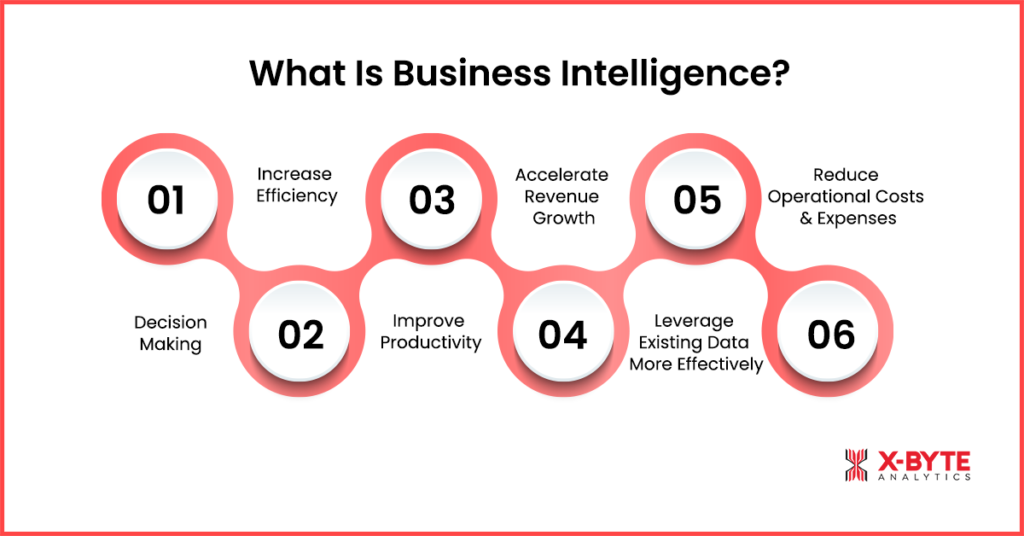
Modern Business Intelligence systems go far beyond static reports. They provide:
- Historical, real-time, and predictive insights
- Interactive dashboards and self-service analytics
- AI-driven pattern recognition and forecasting
- Secure, scalable access to enterprise data
For modern enterprises, BI acts as a decision intelligence layer, enabling leadership teams to understand what is happening, why it is happening, and what is likely to happen next.
Why Business Intelligence Is Essential for Modern Enterprises
Business Intelligence is essential for modern enterprises operating in environments defined by scale, speed, and complexity. As organizations grow, effective decision-making becomes increasingly dependent on accurate, timely, and cross-functional data.
BI delivers a unified view of enterprise performance by breaking down data silos and enabling consistent, data-driven decision-making across departments, regions, and leadership levels. With Business Intelligence, enterprises can transition from reactive decision-making to proactive and predictive strategies.
In highly competitive markets, organizations that leverage BI effectively are better equipped to adapt quickly, continuously optimize operations, and maintain strategic alignment across the enterprise.
Key Components of Modern Business Intelligence
Modern Business Intelligence is built on a foundation of integrated data, advanced data analytics, and intuitive visualization. These components work together to transform raw enterprise data into reliable, actionable insights that support both strategic and operational decision-making.
1. Data Integration and Data Warehousing
Enterprise data originates from multiple internal and external sources. BI systems rely on robust data integration pipelines and centralized data warehouses to consolidate information into a single source of truth, ensuring data consistency, accuracy, and accessibility across the organization.
2. Advanced Analytics and Data Mining
Advanced analytics and data mining enable enterprises to uncover hidden patterns, correlations, and trends within large datasets. These capabilities support predictive modeling, opportunity identification, and early anomaly detection for informed decision-making.
3. Reporting and Data Visualization
BI platforms convert complex datasets into intuitive business intelligence dashboards, charts, and standardized reports. Effective visualization simplifies analysis and enables both technical and non-technical stakeholders to quickly interpret insights and take action.
4. Real-Time and Predictive Analytics
Modern BI solutions deliver real-time monitoring alongside predictive insights. This empowers enterprises to respond immediately to operational changes while proactively planning for future business scenarios.
Together, these core components form a scalable and intelligent BI ecosystem. By integrating data, analytics, and data visualization, enterprises can achieve continuous visibility, faster insights, and sustained data-driven decision-making.
Boost Efficiency with Business Intelligence – Explore Data-Driven Strategies for Success
Key Benefits of Business Intelligence for Enterprises
Business Intelligence empowers enterprises to transform raw data into actionable insights that drive strategic, operational, and financial decisions. By leveraging BI, organizations can improve agility, enhance decision-making, and maintain a competitive edge in dynamic markets. Below are the benefits of Business Intelligence for Enterprise.
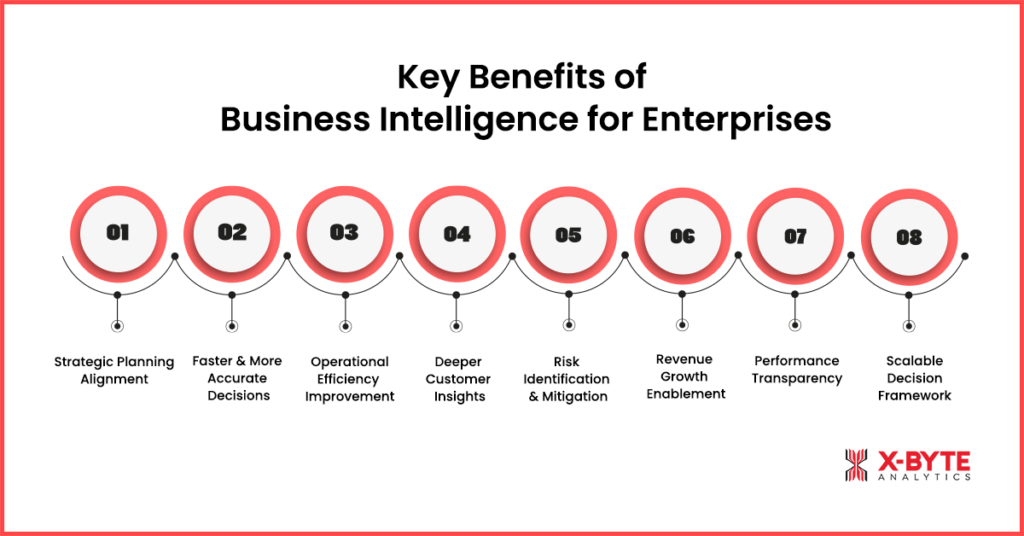
1. Strategic Planning Alignment
Business Intelligence helps enterprises align long-term business strategies with historical performance data, predictive analytics, and market trends. This enables leadership teams to make informed strategic decisions based on accurate and reliable data rather than assumptions.
2. Faster and More Accurate Decisions
Real-time BI insights reduce decision-making delays and minimize reliance on outdated or fragmented reports. Enterprises can respond swiftly to operational and market changes with confidence.
3. Operational Efficiency Improvement
BI identifies inefficiencies across business processes and workflows. By analyzing performance metrics, enterprises can streamline operations, reduce costs, and improve overall productivity.
4. Deeper Customer Insights
Advanced analytics provide enterprises with a holistic understanding of customer behavior, preferences, and engagement patterns. These insights enable personalized experiences and improved customer satisfaction.
5. Risk Identification and Mitigation
Business Intelligence supports proactive risk management through trend analysis, anomaly detection, and compliance monitoring. Enterprises can detect potential risks early and implement preventive measures.
6. Revenue Growth Enablement
Data-driven insights help enterprises uncover new revenue opportunities through pricing optimization, market expansion analysis, and targeted cross-selling strategies.
7. Performance Transparency
Enterprise dashboards provide continuous visibility into KPIs and overall business performance. This transparency enhances accountability and helps leadership track progress against organizational objectives.
8. Scalable Decision Framework
Modern BI platforms are designed to scale alongside enterprise growth. As data volumes and analytical requirements increase, BI systems evolve without compromising performance, reliability, or insight quality.
By leveraging these benefits, enterprises can create a data-driven culture, improve operational efficiency, and make strategic decisions that drive sustainable growth and long-term success.
Challenges Enterprises Face Without Business Intelligence
Enterprises without Business Intelligence often struggle to manage increasing data volumes and growing analytical complexity. Data silos across departments prevent a unified view of organizational performance, resulting in fragmented insights, inconsistent reporting, and misaligned strategic decisions.
Below are the key challenges enterprises commonly face without an effective BI framework:
- Data silos across departments that limit a consolidated and accurate view of business performance
- Delayed decision-making caused by manual reporting processes and the absence of real-time insights
- Inaccurate or inconsistent reporting due to disconnected and fragmented data sources
- Limited visibility into key performance indicators (KPIs), restricting proactive operational management
- Increased operational and financial risks arising from the lack of analytical monitoring and anomaly detection
- Missed revenue and growth opportunities due to underutilized and inaccessible data
- Difficulty scaling analytics capabilities as enterprise data volume, variety, and complexity increase
Manual reporting not only slows decision-making but also increases the risk of errors and data inconsistencies. Over time, limited analytical visibility reduces organizational agility, weakens risk management, and undermines long-term competitiveness in a data-driven market.
The Future of Business Intelligence for Enterprises
The future of Business Intelligence is being shaped by rapid advancements in data analytics, automation, and artificial intelligence. As enterprises continue to generate and consume vast amounts of data, BI platforms are evolving from traditional reporting tools into intelligent systems that support proactive and predictive decision-making across the organization.
Key trends defining the future of Business Intelligence for enterprises include:
1. AI-Driven and Intelligent Analytics
Business Intelligence platforms are increasingly leveraging AI and machine learning to deliver predictive and prescriptive insights, enabling enterprises to anticipate outcomes and take data-driven actions proactively.
2. Real-Time and Continuous Insights
Future BI systems will focus on real-time data processing, allowing enterprises to monitor operations continuously and respond instantly to changing business conditions.
3. Self-Service Analytics for Business Users
Self-service BI tools empower non-technical users to explore data, generate reports, and gain insights independently, reducing reliance on IT teams and accelerating decision-making.
4. Embedded Business Intelligence
BI capabilities are being embedded directly into enterprise applications and workflows, ensuring that insights are available at the point of decision rather than in standalone dashboards.
5. Cloud-Native and Scalable Architectures
Cloud-native BI platforms enable scalability, flexibility, and cost efficiency, supporting growing data volumes and global enterprise operations.
6. Advanced Data Governance and Security
As data complexity increases, future BI solutions will prioritize strong governance, data quality management, and enterprise-grade security to ensure trust and compliance.
Harness Business Intelligence for Growth – Make Better, Faster, and Smarter Decisions
Conclusion
Business Intelligence is a strategic imperative for modern enterprises. By enabling data-driven decision-making, operational optimization, and predictive insights, BI transforms data into a competitive advantage.
With X-Byte Analytics, enterprises gain a trusted partner to build scalable, AI-powered Business Intelligence solutions that deliver measurable business value.
Connect with X-Byte Analytics to unlock the full potential of your enterprise data.